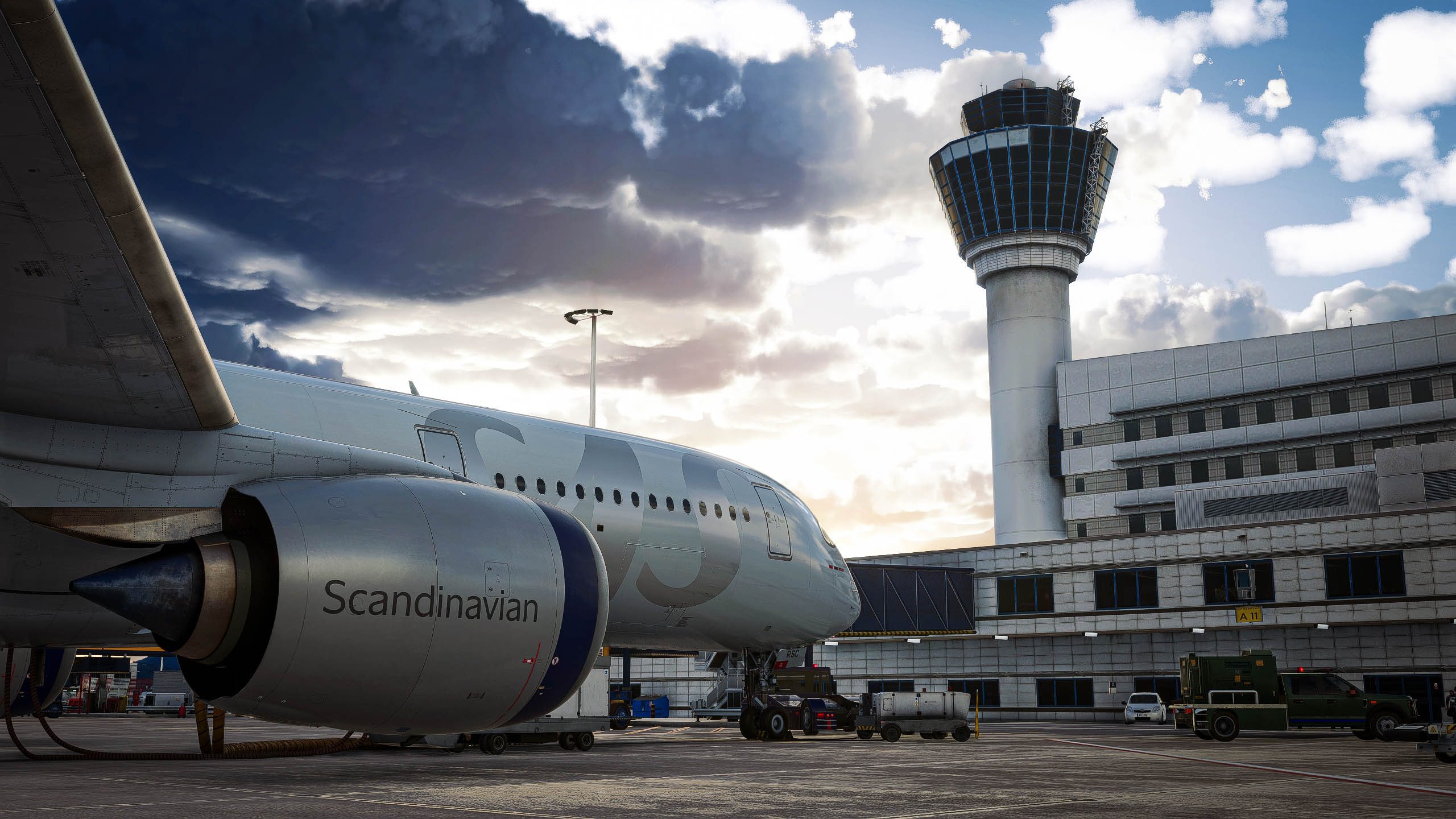
Flight simulation is normally discussed as a training or entertainment technology. For aviation marketers, it can also serve another role: a virtual camera aircraft, giving a creative team a controllable production environment that supplements real-world photography and video.
It does not replace an authentic aircraft, crew, customer experience, or documentary shoot. It can, however, produce cinematic air-to-air perspectives, rare configurations, coordinated formations, unusual weather, global locations, and repeatable sequences that would be expensive, difficult, or impossible to capture consistently in the real world.
Why real air-to-air production is demanding
A true air-to-air shoot usually requires at least two aircraft: the subject and a suitable camera platform. It may also require formation-qualified crews, a safety briefing, route and airspace coordination, fuel, positioning flights, permits, specialist photography equipment, and favorable weather and light. Every additional aircraft, location, or repeat pass adds operational complexity.
Published pricing illustrates the range. Sky Chiefs Aviation advertises aerial-photography aircraft rates of $105 or $140 per hour plus $50 per hour for the pilot. That is a useful entry-level benchmark for a basic aerial platform, not the complete cost of a coordinated commercial air-to-air campaign. At the other end of the spectrum, commercial photographer Andrew Studer lists custom one-hour aircraft photoshoots beginning at $3,250. Aviation photographer Kevin Cleynhens notes that air-to-air flights involving fighters or warbirds can readily cost several thousand euros.
The creative risk is equally important. Weather can erase the planned light, aircraft availability can change, and a missed angle may require another flight. Real production remains invaluable, but it is not always efficient for the continuous volume demanded by social media and digital campaigns.
Simulation changes the production equation
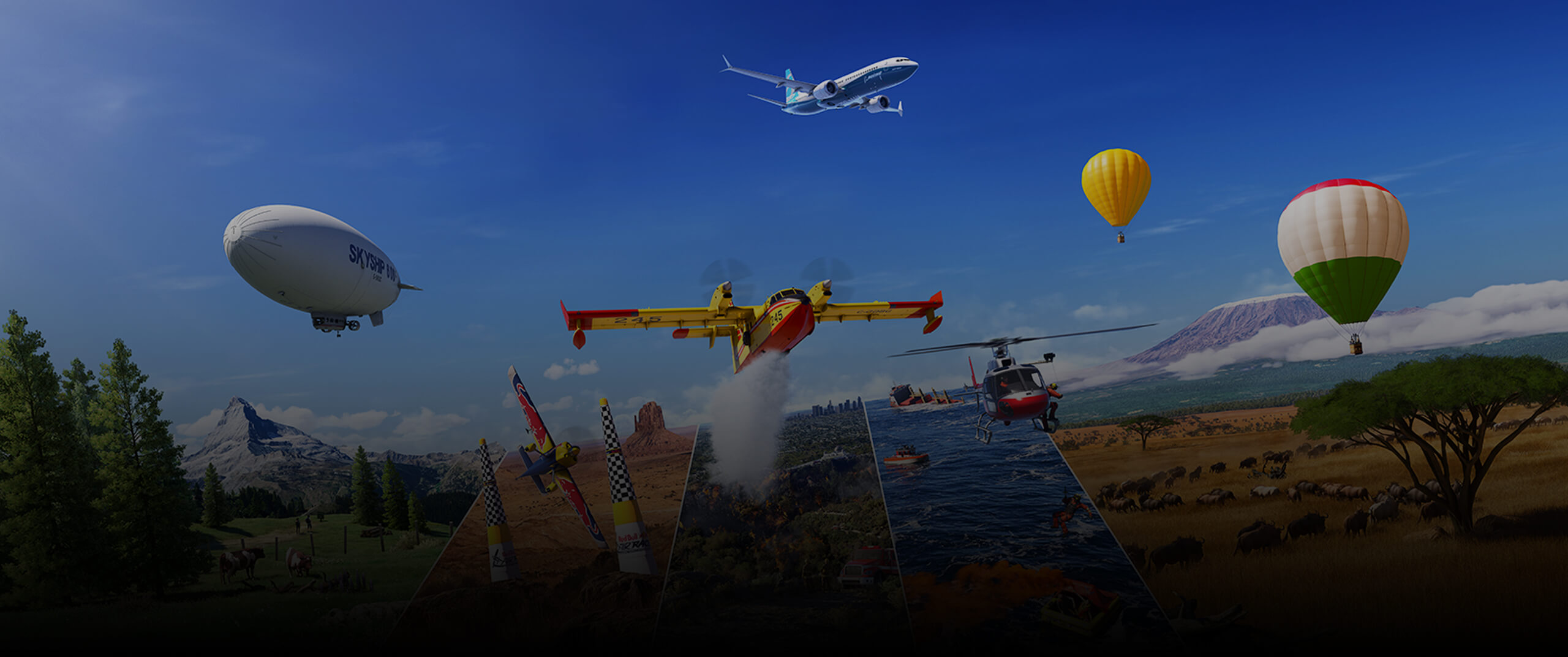
Modern simulators allow a creative team to control aircraft type, livery, time, season, weather, location, camera position, formation, and sequence. A scene can be repeated until the aircraft movement, light, framing, and pacing work together.
One production session can generate horizontal campaign footage, vertical social content, still frames, product-page imagery, announcement teasers, and background assets. That increases the usable content volume without multiplying flight hours, travel days, aircraft repositioning, or weather exposure.
Simulation is particularly useful for:
- Air-to-air angles that would require a dedicated camera aircraft
- Aircraft or liveries not available near the production team
- Historic, military, prototype, or virtual aircraft
- Formation and multi-aircraft sequences
- Location-specific campaigns across several regions
- Previsualizing a real shoot before committing aircraft and crew
- Filling an ongoing content calendar between real-world productions
A different value curve for aviation production
Traditional air-to-air production maximizes physical authenticity but carries high cost, limited repeatability, weather dependence, safety constraints, and scheduling complexity. Generic stock footage lowers cost but sacrifices specificity and brand control. Simulation can occupy a different position: high control, high repeatability, broad aircraft and location access, and relatively low marginal cost per additional variation.
That does not make simulation “better” than real footage. It makes the two tools valuable for different jobs. A Blue Ocean-style eliminate-reduce-raise-create analysis makes the opportunity clear:
- Eliminate positioning flights and physical risk for purely virtual scenes.
- Reduce dependence on weather, aircraft availability, and repeated flight hours.
- Raise creative control, revision flexibility, and asset volume.
- Create scenes, formations, locations, and aircraft combinations that may not be practically obtainable.
The new category is not cheap fake footage. It is aviation virtual production directed by people who understand aircraft, camera movement, light, and brand context.
Fidelity now extends beyond the aircraft model
Convincing aviation imagery depends on more than polygon count. Materials must respond naturally to light. Reflections, atmospheric haze, cloud layers, terrain, motion, exposure, camera movement, and aircraft animation all have to agree within the frame.
NVIDIA describes DLSS 5 as a 3D-guided neural-rendering system designed to bring real-time graphics closer to photorealism by improving lighting and material appearance while preserving the developer's intended visual style. That direction is highly relevant to flight simulation, where painted aluminum, composites, glass, clouds, runway lighting, and complex reflections frequently share the same shot.
It would be premature to claim that DLSS 5 makes simulated aviation universally indistinguishable from real footage. NVIDIA has not published a flight-simulation study demonstrating that result, and discerning viewers can still identify issues in motion, environments, aircraft behavior, or fine details. The more defensible conclusion is that neural rendering will continue narrowing the visible gap. In a carefully directed sequence viewed briefly on a compressed social feed, high-quality simulated footage may already be difficult for a general audience to identify immediately, and the distinction is likely to become less obvious as lighting, materials, animation, and rendering improve.
The strongest approach is hybrid
Simulation should supplement authentic production rather than disguise itself as documentary evidence. Real footage remains essential when the message concerns an actual cabin, facility, crew, service experience, aircraft condition, or operational capability.
A hybrid content system uses each medium where it is strongest. Capture people, facilities, customers, interviews, and tactile details in the real world. Use simulation for air-to-air sequences, transitions, global environments, difficult camera positions, aircraft configurations, or concepts that cannot be captured economically.
This approach can extend a limited real-world shoot into a much larger campaign while maintaining authenticity where authenticity matters most.
The value equation is useful here as well. The brand’s desired outcome is a larger supply of distinctive aviation visuals. Confidence rises when the production partner can show relevant work and demonstrate aviation knowledge. Time delay falls because scenes can be revised without reorganizing a flight. Effort and sacrifice fall because the client does not need to coordinate every visual through a live aircraft operation.
The strongest offer is therefore not “simulator footage by the hour.” It is a defined campaign asset system: creative direction, aircraft and environment planning, cinematic capture, multiple aspect ratios, still extractions, color treatment, sound design, and a clear disclosure policy. Packaging the outcome makes the service easier to evaluate than selling isolated editing tasks.
Example: Qantas cinematic reel
View the Qantas cinematic reel
Click to load the embedded Instagram post
Load PostView the Qantas cinematic reel on Instagram
This example demonstrates how simulated air-to-air imagery can be framed, edited, color-treated, and delivered as compelling short-form aviation content.
Disclosure and brand trust
Simulation should not be used to misrepresent a real event or aircraft capability. Where context could reasonably cause confusion, describe the material as a simulation, virtual production, concept visualization, or simulated sequence. Disclosure can be concise without weakening the creative impact.
For brands with aircraft access, simulation increases the range and cadence of content. For developers and virtual-aircraft companies, it is the native medium. In both cases, the value comes from knowledgeable aviation direction rather than rendering technology alone.
Authority and proof should remain honest. Show real examples, identify the production method where confusion is likely, and avoid claiming a simulated sequence documents a real operation. The creative advantage survives disclosure. Deception only weakens the brand asset the content was meant to build.
MAX-G combines aviation knowledge, flight-simulation production, cinematic editing, and commercial strategy to create scalable visual campaigns for aviation and simulation brands. Contact MAX-G to discuss a real-world, simulated, or hybrid production.